Easy Science Experiments for Kids Ages 4–8 Using Things You Have at Home

Have you ever wondered why some things float in water while others sink? Or why ice slowly disappears on a warm day?
Science is happening all around us — even in your kitchen, bathroom, room, or backyard.
You don't need a laboratory full of fancy equipment to explore it. With a few simple things you already have at home, you can make predictions, try little experiments, and discover what happens.
So let's get curious!

Be a Science Detective
A science experiment is not about getting the “right” answer every time.
It's about wondering, making a guess, trying something, and paying attention to what happens.
Before each experiment, ask:
What do I think will happen?
Then try it and see what you discover.
You might be surprised by the answer — and that's where the fun begins!
1. Sink or Float?
What you'll need
A bowl or container filled with water
A few small everyday objects, such as a spoon, a plastic bottle cap, a small toy, and a stone
Before you start
Look at each object and make a prediction: Will it sink or float?
Try it
Fill the bowl with water.
Place one object gently on the surface of the water.
Watch what happens.
Take the object out and try the next one.
Compare your predictions with what actually happened.
What's happening?
Whether an object sinks or floats depends on how its overall density compares with water. Objects that are less dense than water can float, while objects that are more dense than water sink.
The shape of an object can matter too. That's why a large metal ship can float even though the metal itself is much denser than water.
2. What Melts Faster?
What you'll need
2 identical ice cubes
2 small plates
A warm indoor spot and a cooler indoor spot
Before you start
Make a prediction:
Which ice cube do you think will melt faster?
Try it
Put one ice cube on each plate.
Place one plate in the warmer spot and the other in the cooler spot.
Leave both ice cubes in place.
Check them after a few minutes.
Keep watching until you can see a clear difference.
Compare what happened with your prediction.
What's happening?
Ice melts when it absorbs enough heat from its surroundings to change from a solid into liquid water.
The ice cube in the warmer surroundings should generally melt faster because it receives heat more quickly.
This experiment gives children a simple way to observe how temperature can affect the speed of a change.

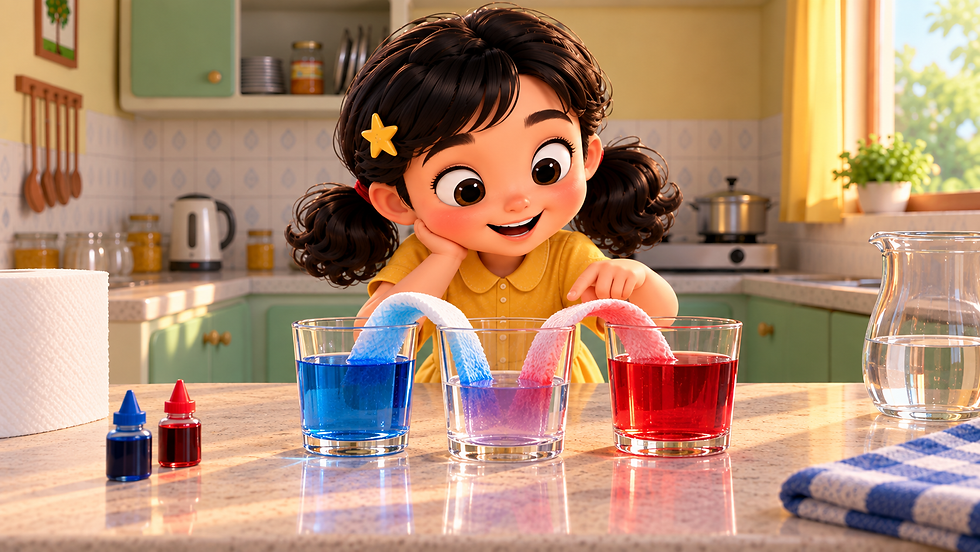
3. Walking Water
What you'll need
3 clear glasses or small jars
Water
Food colouring in two different colours
2 strips of paper towel
Before you start
Make a prediction:
Can water move from one glass to another without anyone pouring it?
Try it
Fill the first and third glasses about halfway with water.
Add a few drops of one food colour to the first glass and a different colour to the third glass.
Leave the middle glass empty.
Fold two paper towels into long strips.
Put one end of the first paper towel into the coloured water in the first glass and the other end into the empty middle glass.
Put one end of the second paper towel into the coloured water in the third glass and the other end into the middle glass.
Leave the setup alone and watch what happens.
What's happening?
The water moves through the tiny spaces between the fibres of the paper towel. This movement is called capillary action.
As the coloured water travels into the middle glass from both sides, the two colours can eventually mix.
It's a fun way to see that water can move through a material even when we don't pour it.
4. Make a Rainbow with Water
What you'll need
A shallow bowl or container
Water
A small mirror
A sheet of white paper
A sunny spot
Before you start
Make a prediction:
Can sunlight and water make a rainbow?
Try it
Fill the bowl with water.
Ask an adult to place the mirror in the water at an angle, with part of the mirror above the water.
Place the bowl where sunlight can shine onto the mirror.
Hold the white paper where the reflected light from the mirror falls.
Slowly adjust the angle of the mirror and paper until you see the light spread into different colours.
Look closely at the colours you can see.
What's happening?
Sunlight may look white, but it is made up of many different colours.
When sunlight passes through water, the light can bend and separate into different colours. The mirror helps redirect the light so you can see those colours on the white paper.
That is similar to what happens when sunlight passes through raindrops in the sky and creates a rainbow.
Safety note: An adult should handle the mirror and help position it. Never look directly at the Sun or shine reflected sunlight into anyone's eyes.

5. Build a Foil Boat
What you'll need
A sheet of aluminum foil
A bowl, tub, or sink filled with water
A few small coins or other small objects to use as cargo
Before you start
Make a prediction:
How many coins do you think your foil boat can carry before it sinks?
Try it
Shape the aluminum foil into a small boat with raised sides.
Fill the bowl, tub, or sink with water.
Gently place your boat on the surface of the water.
Slowly add one coin at a time to the boat.
Keep adding coins carefully and watch what happens.
Count how many coins your boat carries before it sinks.
Try making a new boat with a different shape. Can your new design carry more?
What's happening?
A boat floats because the water pushes upward on it. This upward force is called buoyancy.
The shape of the foil boat allows it to displace enough water to support the boat and its cargo. As you add more coins, the boat gets heavier and sits lower in the water. Eventually, it cannot displace enough water to support the total weight, and it sinks.
Safety note: Aluminum foil can have sharp edges after cutting or folding, so an adult should help younger children handle it.

6. Which Paper Towel Absorbs More?
What you'll need
2–3 different types of paper towels
A pair of scissors
A bowl or glass of water
A kitchen scale, if you have one
A small plate or tray
Before you start
Make a prediction:
Which paper towel do you think will absorb the most water?
Try it
Cut equal-sized pieces from each type of paper towel.
Weigh one dry piece of each type and note the weight.
Place one paper towel piece in the water for the same amount of time.
Take it out and let the extra water drip off for a few seconds.
Weigh the wet paper towel.
Repeat the same steps with the other types of paper towel.
Compare how much the weight increased for each towel.
What's happening?
Paper towels are made from plant fibres called cellulose. Tiny spaces between the fibres can hold water, while water also sticks to the fibres.
When a paper towel absorbs water, its weight increases. By comparing how much each towel's weight increases, you can get an idea of how much water each one absorbed.
There may not be one “best” paper towel for every test. Different towels can have different materials, thicknesses, and structures, so the result depends on the towels you test.
Safety note: An adult should help with scissors and the kitchen scale if needed.

7. Make a Shadow Change
What you'll need
A sunny outdoor spot
A small toy or other object that can stand upright
Sidewalk chalk
A clock or timer
Before you start
Make a prediction:
What do you think will happen to the shadow as time passes?
Try it
Place the toy or object in a sunny spot where its shadow can fall on the ground.
Use chalk to trace around the shadow.
Note the time.
Wait about 30–60 minutes.
Trace the shadow again.
Compare the two shadows. Did the shadow move? Did its length or direction change?
If you have time, repeat the activity once or twice more and compare all the shadows.
What's happening?
A shadow forms when an object blocks some of the light from the Sun.
As Earth rotates, the Sun appears to move across the sky. Because the sunlight reaches the object from different angles during the day, the shadow changes its position and can also become longer or shorter.
It's a simple way to see Earth's rotation in action — right in your own backyard!
Safety note: Never look directly at the Sun. An adult should help children choose a safe outdoor spot for the experiment.

Keep Exploring!
Science doesn't have to happen in a classroom or a laboratory.
It can happen at the kitchen sink, on a sunny afternoon, or right at your own table.
Keep asking questions, making predictions, and trying little experiments. You never know what you might discover!
And remember — there is always another “Why?” waiting to be explored.
Stay curious… the world is full of surprises. ✨
Comments